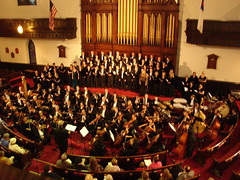
Dyah sent me some great music mission kiev photos -- and in the process, she set up a flickr page for all church photos. I'll be getting more info out about this later on the church webpage. In the meantime, check out these beauties that Dyah took!
Wednesday, November 01, 2006
Music Mission Kiev Photos
Dyah sent me some great music mission kiev photos -- and in the process, she set up a flickr page for all church photos. I'll be getting more info out about this later on the church webpage. In the meantime, check out these beauties that Dyah took!
Tuesday, October 31, 2006
Halloween -- some thoughts
I don't really have a lot to add to the Christian blogosphere's discussions about Halloween. There are two main camps that catch my attention: Halloween is evil (and thus should be shunned at all costs as a holiday belonging to Satan) and Halloween is a missional opportunity (while there are some disturbing elements, it is a great time to interact with neighbors in a friendly relaxed atmosphere).
I think Tim Challies nails it in his post:
Rob Wilkerson has a thoughtful critique however of the horror element that has really creeped into Halloween celebration the past 20 years. He writes about contemporary horror/splatter films:
I wrestled with this a little bit back in July in the A Call for Sanity Pleasepost.
I'm not sure that Halloween has such direct links to satanism as it does to consumerism. I've been reading cultural histories of Halloween -- written by real scholars who look at real primary sources. Most interesting has been Death Makes a Holiday by David Skal. Skal shows that the roots of Halloween are in many different holidays (such as Guy Fawkes day) -- the connections to Samhain in Ireland are tenuous at best. Ultimately, Skal suggests, Halloween is a uniquely American holiday. In some ways, Halloween becomes what we make of it.
I don't have a word from the Lord on this -- I don't have authoritative teaching. However, I see nothing wrong with children playing dress up in appropriate outfits and going door to door in a neighborly attempt to ask for candy. I am, however creeped out by haunted houses, glorification of the macabre, and fascination with the occult. I'm disturbed that adult Halloween parties are opportunities for grown women to parade themselves as tramps -- and I'm bothered that Halloween has become an excuse in some urban areas to indulge in yet another freewheeling party.
But I'm still passing out candy to kids tonight....
what about you?
Excelsior
Russell
I think Tim Challies nails it in his post:
Perhaps the greatest fallacy Christians believe about Halloween is that by refusing to participate in the day we are somehow taking a stand against Satan. And second to that, is that participation in the day is an endorsement of Satan and his evil holidays. The truth is that Halloween is not much different from any other day in this world where, at least for the time being, every day is Satan's day and a celebration of him and his power. A member of the discussion discussion list wrote the following last year around this time: "Yeah... I've heard all of the 'pagan' reasons Christians should avoid Halloween. The question is whether we are actually participating in Samhain when we participate in Halloween? Who or what makes the 'Witch's League of Public Awareness' the definers of what Halloween is, either now or historically? Such a connection between Samhain and my daughter as a ladybug or my son as a Bengals Boy is highly dubious." And it is highly dubious at best.
Rob Wilkerson has a thoughtful critique however of the horror element that has really creeped into Halloween celebration the past 20 years. He writes about contemporary horror/splatter films:
My son asked me yesterday as we were shopping together why we don't watch movies like that. As with me at his age, they produced a certain boyish fascination that comes with a beloved naievete whose bliss is most welcome at ten years old. I simply responded with one answer: "If you were watching someone torture your little brothers or sister would you want someone to pay to watch it and laugh at it and then walk away commenting to a newspaper that they enjoyed it?" He cringed with justifiable horror as he should have. It's all of the sudden different when it's someone you know.
I wrestled with this a little bit back in July in the A Call for Sanity Pleasepost.
I'm not sure that Halloween has such direct links to satanism as it does to consumerism. I've been reading cultural histories of Halloween -- written by real scholars who look at real primary sources. Most interesting has been Death Makes a Holiday by David Skal. Skal shows that the roots of Halloween are in many different holidays (such as Guy Fawkes day) -- the connections to Samhain in Ireland are tenuous at best. Ultimately, Skal suggests, Halloween is a uniquely American holiday. In some ways, Halloween becomes what we make of it.
I don't have a word from the Lord on this -- I don't have authoritative teaching. However, I see nothing wrong with children playing dress up in appropriate outfits and going door to door in a neighborly attempt to ask for candy. I am, however creeped out by haunted houses, glorification of the macabre, and fascination with the occult. I'm disturbed that adult Halloween parties are opportunities for grown women to parade themselves as tramps -- and I'm bothered that Halloween has become an excuse in some urban areas to indulge in yet another freewheeling party.
But I'm still passing out candy to kids tonight....
what about you?
Excelsior
Russell
Monday, October 30, 2006
The Ukrainian Invasion has passed -- thoughts on Music Mission Kiev 2006
Posting was light last week because we were preparing for the Ukrainian invasion of Cincinnati. This weekend, we hosted Music Mission Kiev in two concerts for their 2006 eastern US tour. We've been preparingg for a year -- arranging for housing, raising money, selling tickets, prepping advertising, working with other churches, contacing media sources, and prepping our sanctuary (we had to move two rows of pews and all our very heavy pulpit furniture).
They provided two stunning, simply stunning concerts -- standing ovations at both intermission and conclusion. I've been fielding calls and emails all day from people who told me the concerts brought tears to their eyes. I've been spending all day basking in the after-glow of the glory of the weekend -- it's kind of a remnant of God in his common grace touching our hearts through created beauty (see my previous post on The Artist and the Jock for a more extended reflection on this).
As I process this weekend's experience, I wanted to share a few stories with you from the concerts:
First were obvious God moment: In Saturday night's concert, a beautiful late 50s blonde woman came forward, red shawl draped daringly around her shoulders, and sang a lovely traditional Ukrainian song. Her eyes were radiant and she was animated. Meanwhile, sitting next to me and Tammy was a young twentysomething man, tears streaming down his reddened cheeks into his ample beard. At the end of the song, the woman put her fingertips to her mouth and blew them toward the young man. I leaned over to look again at his face as the crowed thundered applause. His wife leaned from his other side to say to me "that was his mother". At intermission, we spoke -- he hasn't seen his mother since the last time Music Mission Kiev came to Cincinnati -- and his wife had never met her mother in law. Blessedly, the director of the Orchestra, Roger McMurrin, gave this lovely lady the next day off so she could spend it with her son.
Then there was the appreciation of the performers. I love hearing our church people being affirmed -- and they received tons of affirmation. Our dear friend Mary Dillon coached our kitchen co-ordinators on what kinds of meals would be traditional Ukrainian meals. Our kitchen volunteers pulled out all the stops, and as our Ukrainian friends were leaving, I had more than one person tell me that our meals were the best meals they had on the entire tour. Mary, when she came into the dining hall last night to check on everyone, received enthusiastic applause for her work. Our kitchen team did a great work.
Meanwhile our facility got rave reviews as well -- the musicians told us that acoustically, ours was one of the best venues they've ever performed in on tour. They sang and played their hearts out, in part because they knew that with our acoustics they would sound great. And believe me, they did.
The people who housed musicians came talking about the host and hostess gifts that they recieved and the warmth with which our Ukrainian friends received hospitality. I delighted in seeing one of our dignified gentlemen in church come to the Sunday concert with a scarf sized Ukrainian flag draped about his neck. When I asked him about it, he told me that the performer that he and his wife hosted gave it to him, and he could think of no better way of honoring the gift than by wearing it with pride to show his appreciation to her.
Then there were the stories. Roger spoke in both concerts about the Mission's work with widows and orphans -- he told us about their orphan ministry taking on 100 new children. He told us how they provide food for over 500 widows each month. He drew an audible gasp on Saturday night when he told us of their medical work -- that they could arrange for cataract surgery for a blind widow for only $50.
Our team is already talking about arranging a group to go over to Kiev, perhaps in summer of 2007.
The Spirit moved mightily in and among our people this weekend. I pray that the blessing will continue.
Soli Deo Gloria
Russell
Thursday, October 26, 2006
Chicago Trip -- the Pirate Queen
Tammy told me she had a surprise for me. She gets this little giggly grin when she has surprises, and then inevitably comes the question "Do you want to know what it is?" My customary response is "Wouldn't that spoil the effect of the surprise?" -- this is something of a litany in our house -- much like "The Lord be with you" "And also with you"
Usually, I wind up being told about the surprise -- and this time was no exception. Tammy told me that on our trip to Chicago we would be going to see a new musical from the creators of Les Miserables, the musical.
Some background. When my parents took me to New York in the 11th grade, all I wanted to do was see theatre (I was very involved in theatre at that time -- eomehow they managed to make me also see the United Nations, the Met Museum, and Central Park -- but they also took me to see lots of great theater on Broadway -- I have great parents). Somehow, they had gotten us front row tickets for a Boublil and Schoenberg's adaptation of Les Miserables, which in 1988 was still a relatively new production. Set in post-revolutionary france, it is the story of Jean Valjean, a fugitive from an the law who is trying to rebuild his life. Valjean finds God and dedicates himself to trying to be a good decent person -- he and his adopted daughter are pursued by the relentless Inspector Javert and hounded by the villanous con-man and extortionist Thenardier. All these characters get caught in the curious blend of idealism and revolt and revolution in mid 1800s Paris. The musical is basically a rock opera -- big and splashy with lots of passion, energy, gunfire, big stages, loves lost, deeds of nobility, betrayal, reconciliation, and a ripping good ending that hints at the hope of resurrection and reconciliation in the world beyond. The villans were complex and compelling. And the heroes were noble and strong. It was the perfect musical for a Lord of the Rings loving 17 year old.
I memorized the soundtrack. I'd regularly sing the whole thing on drives from college back home. I even got a ticket once for running a traffic light while I was immersed in singing along with the soundtrack. The musical inspired me to slog through Victor Hugo's immense tome (hundreds of richly detailed pages -- each one of them a sermon -- well worth the investment of time) and to enjoy the Liam Neeson/Jeffery Rush portrayals in the 1998 version of the film (IMDB lists 19 different film versions -- one as far back as 1917 -- read the wikipedia article on Les Miserables -- it's had huge cultural impact). I joined PBS to receive the complementary VCR tape of the 10th anniversary concert featuring the "all star cast".
Get the idea? I kind of liked the musical. (did I really talk about "a bit excessive" in my last post?)
Now, put yourself back into my chair 4 weeks ago when Tammy told me that we were seeing a new musical from the same collaborators who adapted Les Miserables to stage. I was thrilled. I went straight to the website for, this musical, titled The Pirate Queen -- it looked good. Ireland, pirates, celtic music, dance, swordfighting. I couldn't wait.
So after a great meal of authentic Chicago pizza, we settled into our seats at the Cadillac Palace Theatre. We thrilled to the swelling music of the overture. And we let the story begin. It's the story of Grace O'Malley, a contemporary of Queen Elizabeth. Both Grace and Elizabeth grow up in the shadow of their fathers who were leaders of their respective peoples. Grace grows up with love and affection and affirmation -- and she learns that leadership comes with hard choices for the good of the community. Elizabeth's father, Henry VIII is most conspicuous in his absence -- she says at her coronation that she'll be just like him as a ruler. And she's stern and harsh, especially against these upstart pirates in Ireland. As these two strong women set themselves against each other, there is bloodshed, violence, and lots of stylized stage swordfighting. The play comes to a climactic resolution when the two women meet face to face and speak as woman to woman, rather than as ruler to ruler. They reach an understanding and banish the scheming courtier who was playing the conflict to his advantage.
The worst I can say about this is that it's a very good show -- lots of great Irish dancing -- outstanding performances (the villans, while well played, were written rather flat -- I saw no evidence of the streak of nobility that made inspector Javert so compelling, nor of the ruthless cleverness of Thenardier). Memorable songs and a stunning set/costume design guarantee that this will be an enjoyable show. But it's not Les Miz.
Nor could it ever be. How could anything compare to the mythic proportions that show took on in my mind. It would be unfair to compare the two. I saw Les Miz when I was an impressionable 17 year old filled with the starry eyed dreams of youth. I read the same story now, and I no longer identify with the herioic young Marius. I cherish the play for the place it held in my life a decade ago. Just like aging baby boomers who cherish Woodstock (and believe me, I really just don't get that), so have I treated Les Miz. Therefore The Pirate Queen could never fill that role for me.
But it might some day for my daughters.....
Like I said, I keyed into the part of the story being about fathers and daughters. This show features strong women who are heroes. Who knows.....
Excelsior
Russell
Usually, I wind up being told about the surprise -- and this time was no exception. Tammy told me that on our trip to Chicago we would be going to see a new musical from the creators of Les Miserables, the musical.
Some background. When my parents took me to New York in the 11th grade, all I wanted to do was see theatre (I was very involved in theatre at that time -- eomehow they managed to make me also see the United Nations, the Met Museum, and Central Park -- but they also took me to see lots of great theater on Broadway -- I have great parents). Somehow, they had gotten us front row tickets for a Boublil and Schoenberg's adaptation of Les Miserables, which in 1988 was still a relatively new production. Set in post-revolutionary france, it is the story of Jean Valjean, a fugitive from an the law who is trying to rebuild his life. Valjean finds God and dedicates himself to trying to be a good decent person -- he and his adopted daughter are pursued by the relentless Inspector Javert and hounded by the villanous con-man and extortionist Thenardier. All these characters get caught in the curious blend of idealism and revolt and revolution in mid 1800s Paris. The musical is basically a rock opera -- big and splashy with lots of passion, energy, gunfire, big stages, loves lost, deeds of nobility, betrayal, reconciliation, and a ripping good ending that hints at the hope of resurrection and reconciliation in the world beyond. The villans were complex and compelling. And the heroes were noble and strong. It was the perfect musical for a Lord of the Rings loving 17 year old.
I memorized the soundtrack. I'd regularly sing the whole thing on drives from college back home. I even got a ticket once for running a traffic light while I was immersed in singing along with the soundtrack. The musical inspired me to slog through Victor Hugo's immense tome (hundreds of richly detailed pages -- each one of them a sermon -- well worth the investment of time) and to enjoy the Liam Neeson/Jeffery Rush portrayals in the 1998 version of the film (IMDB lists 19 different film versions -- one as far back as 1917 -- read the wikipedia article on Les Miserables -- it's had huge cultural impact). I joined PBS to receive the complementary VCR tape of the 10th anniversary concert featuring the "all star cast".
Get the idea? I kind of liked the musical. (did I really talk about "a bit excessive" in my last post?)
Now, put yourself back into my chair 4 weeks ago when Tammy told me that we were seeing a new musical from the same collaborators who adapted Les Miserables to stage. I was thrilled. I went straight to the website for, this musical, titled The Pirate Queen -- it looked good. Ireland, pirates, celtic music, dance, swordfighting. I couldn't wait.
So after a great meal of authentic Chicago pizza, we settled into our seats at the Cadillac Palace Theatre. We thrilled to the swelling music of the overture. And we let the story begin. It's the story of Grace O'Malley, a contemporary of Queen Elizabeth. Both Grace and Elizabeth grow up in the shadow of their fathers who were leaders of their respective peoples. Grace grows up with love and affection and affirmation -- and she learns that leadership comes with hard choices for the good of the community. Elizabeth's father, Henry VIII is most conspicuous in his absence -- she says at her coronation that she'll be just like him as a ruler. And she's stern and harsh, especially against these upstart pirates in Ireland. As these two strong women set themselves against each other, there is bloodshed, violence, and lots of stylized stage swordfighting. The play comes to a climactic resolution when the two women meet face to face and speak as woman to woman, rather than as ruler to ruler. They reach an understanding and banish the scheming courtier who was playing the conflict to his advantage.
The worst I can say about this is that it's a very good show -- lots of great Irish dancing -- outstanding performances (the villans, while well played, were written rather flat -- I saw no evidence of the streak of nobility that made inspector Javert so compelling, nor of the ruthless cleverness of Thenardier). Memorable songs and a stunning set/costume design guarantee that this will be an enjoyable show. But it's not Les Miz.
Nor could it ever be. How could anything compare to the mythic proportions that show took on in my mind. It would be unfair to compare the two. I saw Les Miz when I was an impressionable 17 year old filled with the starry eyed dreams of youth. I read the same story now, and I no longer identify with the herioic young Marius. I cherish the play for the place it held in my life a decade ago. Just like aging baby boomers who cherish Woodstock (and believe me, I really just don't get that), so have I treated Les Miz. Therefore The Pirate Queen could never fill that role for me.
But it might some day for my daughters.....
Like I said, I keyed into the part of the story being about fathers and daughters. This show features strong women who are heroes. Who knows.....
Excelsior
Russell
Wednesday, October 25, 2006
Lifelogging -- isn't this a bit excessive?
The cover story of this month's Fast Company Magazine -- Gordon Bell, a 72 year old retired Microsoft programmer, and his experiment in Lifelogging.
What, pray tell, is lifelogging? I'm glad you asked. As we've seen on the internet, people are recording and sharing their lives in intimate detail. Blogging, photo-sharing, IPod lists, YouTube videos, and cheap data storage all combine with rapidly advancing technology to create the capacity for archival and retreival of massive amounts of information.
I call my laptop my "portable brain" -- I have on it now about 7 years worth of notes, musings, writings, articles I've read -- all organized in an A-Z file cabinet that mirrors my hard copy file cabinets at office and home. When something tickles my brain, I can perform a few searches and voila, there is what I'm looking for (though it does at times take longer than "voila" -- Monday I spent about 20 minutes looking for a story that I'd used in a sermon).
Used as a memory aid, this technology can be wonderful -- it can assist us in making new connections and in producing good, interesting, and helpful work. It also naturally assists those of us who are collectors and connectors, but not necessarily organizers. Memory is a wonderful and delightful thing -- Biblically, memory connects the past generations of the covenant community with the future generations. How often are the Israelites told to remember the words that God has given them. How often are stories (particularly the Exodus) retold ad infinitum because memory of the mighty acts of God is a vital part of our faith. Consider Peter's words in his second letter: "So I will always remind you of these things, even though you know them and are firmly established in the truth you now have. I think it is right to refresh your memory as long as I live....and I will make every effort to see that after my departure you will always be able to remember these things." (2 Peter 1:12-13,15). In so far as we have technical assistance in remembering those things that are helpful, needful, and important -- so to the good.
But lifelogging is a bit different.
Trendwatching.com gives us some help in understanding lifelogging (a trend they call Lifecaching):
Did you catch that last sentence -- "every second of their existence" -- the folks at Trendwatching are engaging in a little hyperbole -- a little exaggeration to show the magnitude of data that can be archived. However Gordon Bell is taking them at their word. In the Fast Company Article, he demonstrates that he's trying to archive everything:
Yep -- everything. And the article's author confesses a kind of awe at Bell's ability to dredge up tidbits from phone conversations and from other places. However, there's a dark side -- the article relates how Bell was conversing with his "significant other" one evening and she said "did you just record that?" he grinned sheepishly and said "yep". "Delete it! Delete it!" she yelled. Apparantly, she didn't relish the idea of her offhand comments being preserved for all posterity. Then consider college students who make the mistake of posting their hard partying stories on MySpace -- this is one of the first places potential employers go now in researching a candidate. Pictures of a drunken evening -- oops, maybe you don't want to remember that either. The article mentions confidential internal Microsoft memos that are a part of Bell's archive -- I'm not sure how the company will feel about that now that he's retired.
A part of wisdom lies in knowing what to save and what not to save. I have found that I must continually go through my files and pitch things -- not everything is valuable and helpful, and it distracts my attention to have to filter through unnecessary things to find what I need.
A dramatic example from David Shenk's book The Forgetting: Alzheimer's, portrait of an epidemic relates the case history of S (name omitted from the doctor's records). In the 1920’s, S was reporter in Moscow who got in trouble for never taking notes in staff meetings. His editor challenged him one day, and S repeated word for word everything that had been said in the meeting. The shocked editor sent S to Dr. Luria who tested him and found no limit to his amazing capacity for memory. He could look at tables of random numbers for just a few minutes and re-create them flawlessly. Once he looked at those tables, he could reproduce them at any time -- even 20 years later. He came about as close as it gets to Bell's ideal of total memory.
But because of his immense capacity to remember precise, he didn’t notice abstract things like patterns. He couldn’t understand poetry - the nuance and playfulness of symbol, allusion, and reference were lost on him. He had trouble connecting faces with identities because faces are so changeable. Every day there's a different expression, a new wrinkle, a change of haircut, different jewelry -- he couldn't abstract from all those things to see the consistency over time. Thus, he came across as unmotivated and dim witted. He couldn’t forget enough to form general impressions and derive meaning. He was literally lost in the details. (59-60)
The art of classification, abstraction, categorization, and yes purging information is a part of what we call wisdom. Another part is quite simply what do we do with information -- to what end do we save and archive all this data -- is it for self aggrandizement -- is it to be able to say "aha!" when we can one-up someone by dredging up a conversation from 10 years ago? If so, is the archiving worth the trouble at all. I'm all for using technological aides to memory (the above story of S was archived on my computer from my reading notes of Shenk's book). But surely there's a way wisdom is involved in the process as well.
Let me know what you think on this one -- it's an intriguing cultural trend.
Soli Deo Gloria
Russell
What, pray tell, is lifelogging? I'm glad you asked. As we've seen on the internet, people are recording and sharing their lives in intimate detail. Blogging, photo-sharing, IPod lists, YouTube videos, and cheap data storage all combine with rapidly advancing technology to create the capacity for archival and retreival of massive amounts of information.
I call my laptop my "portable brain" -- I have on it now about 7 years worth of notes, musings, writings, articles I've read -- all organized in an A-Z file cabinet that mirrors my hard copy file cabinets at office and home. When something tickles my brain, I can perform a few searches and voila, there is what I'm looking for (though it does at times take longer than "voila" -- Monday I spent about 20 minutes looking for a story that I'd used in a sermon).
Used as a memory aid, this technology can be wonderful -- it can assist us in making new connections and in producing good, interesting, and helpful work. It also naturally assists those of us who are collectors and connectors, but not necessarily organizers. Memory is a wonderful and delightful thing -- Biblically, memory connects the past generations of the covenant community with the future generations. How often are the Israelites told to remember the words that God has given them. How often are stories (particularly the Exodus) retold ad infinitum because memory of the mighty acts of God is a vital part of our faith. Consider Peter's words in his second letter: "So I will always remind you of these things, even though you know them and are firmly established in the truth you now have. I think it is right to refresh your memory as long as I live....and I will make every effort to see that after my departure you will always be able to remember these things." (2 Peter 1:12-13,15). In so far as we have technical assistance in remembering those things that are helpful, needful, and important -- so to the good.
But lifelogging is a bit different.
Trendwatching.com gives us some help in understanding lifelogging (a trend they call Lifecaching):
Point in case: collecting! Human beings (fueled by a need for self-worth, validation, control, vanity, even immortality) love to collect and store possessions, memories, experiences, in order to create personal histories, mementoes of their lives, or just to keep track for practical reasons. And with the experience economy still gaining ground -- with consumers more often favoring the intangible over the tangible -- collecting, storing and displaying experiences is ready for its big moment.
Why? Well, thanks to the onslaught of new technologies and tools, from blogging software to memory sticks to high definition camera phones with lots of storage space and other 'life capturing and storing devices', an almost biblical flood of 'personal content' is being collected, and waiting to be stored to allow for ongoing trips down memory lane (see also our GENERATION C trend).
TRENDWATCHING.COM has dubbed this emerging mega trend 'LIFE CACHING': collecting, storing and displaying one's entire life, for private use, or for friends, family, even the entire world to peruse. The LIFE CACHING trend owes much to bloggers: ever since writing and publishing one's diary has become as easy as typing in www.blogger.com, millions of people have taken to digitally indexing their thoughts, rants and God knows what else; all online, disclosing the virtual caches of their daily lives, exciting or boring. Next came moblogging, connecting camera phones to online diaries, allowing not only for more visuals to be added to blogs, but also for real-time, on the go postings of experiences and events. And that's still just the beginning.
Why do we think this trend is ready to take off? Well, the necessary enablers are now all in place: required hardware and software are ubiquitious, there's ample availability of affordable storage space, blogging mentality is hitting the masses, and some of the major 'new economy' brands are getting in on the game, promising mass LIFE CACHING products at mass prices. We're talking Nokia, Microsoft, Google, Apple, Samsung and many more. All of this is putting in place an infrastructure for LIFE CACHING that will soon have GENERATION C and 'Generation Digital' caching every second of their existence.
Did you catch that last sentence -- "every second of their existence" -- the folks at Trendwatching are engaging in a little hyperbole -- a little exaggeration to show the magnitude of data that can be archived. However Gordon Bell is taking them at their word. In the Fast Company Article, he demonstrates that he's trying to archive everything:
For the past seven years, Bell has been conducting an audacious experiment in "lifelogging"--creating a near-total digital record of his experience. His custom-designed software, "MyLifeBits," saves everything it can get its hands on. For every piece of email he sends and receives, every document he types, every chat session he engages in, every Web page he surfs, a copy is scooped up and stashed away. MyLifeBits records his telephone calls and archives every picture--up to 1,000 a day--snapped by his automatic "SenseCam," that device slung around his neck. He has even stowed his entire past: The massive stacks of documents from his 47-year computer career, first as a millionaire executive then as a government Internet bureaucrat, have been hoovered up and scanned in. The last time he counted, MyLifeBits had more than 101,000 emails, almost 15,000 Word and PDF documents, 99,000 Web pages, and 44,000 pictures.
Yep -- everything. And the article's author confesses a kind of awe at Bell's ability to dredge up tidbits from phone conversations and from other places. However, there's a dark side -- the article relates how Bell was conversing with his "significant other" one evening and she said "did you just record that?" he grinned sheepishly and said "yep". "Delete it! Delete it!" she yelled. Apparantly, she didn't relish the idea of her offhand comments being preserved for all posterity. Then consider college students who make the mistake of posting their hard partying stories on MySpace -- this is one of the first places potential employers go now in researching a candidate. Pictures of a drunken evening -- oops, maybe you don't want to remember that either. The article mentions confidential internal Microsoft memos that are a part of Bell's archive -- I'm not sure how the company will feel about that now that he's retired.
A part of wisdom lies in knowing what to save and what not to save. I have found that I must continually go through my files and pitch things -- not everything is valuable and helpful, and it distracts my attention to have to filter through unnecessary things to find what I need.
A dramatic example from David Shenk's book The Forgetting: Alzheimer's, portrait of an epidemic relates the case history of S (name omitted from the doctor's records). In the 1920’s, S was reporter in Moscow who got in trouble for never taking notes in staff meetings. His editor challenged him one day, and S repeated word for word everything that had been said in the meeting. The shocked editor sent S to Dr. Luria who tested him and found no limit to his amazing capacity for memory. He could look at tables of random numbers for just a few minutes and re-create them flawlessly. Once he looked at those tables, he could reproduce them at any time -- even 20 years later. He came about as close as it gets to Bell's ideal of total memory.
But because of his immense capacity to remember precise, he didn’t notice abstract things like patterns. He couldn’t understand poetry - the nuance and playfulness of symbol, allusion, and reference were lost on him. He had trouble connecting faces with identities because faces are so changeable. Every day there's a different expression, a new wrinkle, a change of haircut, different jewelry -- he couldn't abstract from all those things to see the consistency over time. Thus, he came across as unmotivated and dim witted. He couldn’t forget enough to form general impressions and derive meaning. He was literally lost in the details. (59-60)
The art of classification, abstraction, categorization, and yes purging information is a part of what we call wisdom. Another part is quite simply what do we do with information -- to what end do we save and archive all this data -- is it for self aggrandizement -- is it to be able to say "aha!" when we can one-up someone by dredging up a conversation from 10 years ago? If so, is the archiving worth the trouble at all. I'm all for using technological aides to memory (the above story of S was archived on my computer from my reading notes of Shenk's book). But surely there's a way wisdom is involved in the process as well.
Let me know what you think on this one -- it's an intriguing cultural trend.
Soli Deo Gloria
Russell
Monday, October 23, 2006
The Oriental Institute in Chicago -- a real treasure trove
Now that we're back from our Chicago excursion, I wanted to take a few posts to process the experience. Yes, it was a pleasure trip -- but my idea of fun is widely regarded by most as eccentric and goofy.
And so it begins -- we checked into our hotel and hopped a bus to Chicago's Hyde Park, where the Oriental Institute is located. I didn't realize that Hyde Park was also home to McCormick Theological Seminary and Chicago Seminary -- among other places.
Why this interest in The Oriental Institute? It is a branch of the University of Chicago dedicated to studies of ancient Near Eastern civilizations -- such as Ancient Assyria, Egypt, Israel, Persia, and Cush. Since all these locales are pretty important to the Bible, I thought that it would be a great place to pay a visit. I was going mainly to check out their exhibit on Egypt, since that is my current area of extracurricular study....I found a lot more than I bargained for.
After going through a modest collection of prehistoric artifacts, I found myself walking straight into the Assyrian gallery, the centerpiece of which are three massive bas-relief slabs from the palace of Sargon II (who incorporated Israel into the Assyrian orbit as a vassal state. His son is the Sennacharib who invaded Israel in II Kings 18). Central to this exhibit is a massive winged lion with a human head -- it took my breath with its immensity and majesty.
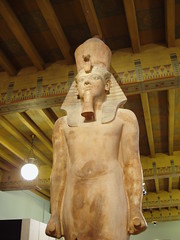
Then, I hurried through the Israel exhibit on Megiddo. I figured I'd be back someday -- our time was limited and I really wanted to see the Egyptian gallery. Right in the doorway of the Egyptian gallery was a huge statue of King Tutankhamen, towering over the entire exhibit. Again, impressive and breathtaking.
The Egyptian exhibit was detailed and informative. In addition to the customary museum work on funeary practices, the exhibit showed lots of detail on writing instruments, musical instruments, items of daily life (such as beds, furntiture, linens, etc), and various professions. They did a terriffic job of laying out lots of material in limited space. Easily the best Egyptian exhibit I've seen in North America.
The Persian Exhibit had more massive pieces -- huge carvings of a bull's head and of a Persian sphynx. I finally began to consider that all this majesty was to a purpose. The buildings of the ancients (not unlike the buildings of today) were created to impress -- as the common person walked by the palace or the courts of justice, they were supposed to be in awe of the power of the king. All these structures served to stir admiration, wonder, and fear at the might of the potentate who brought these buildings into existence. This is the kind of awe that scripture talks about when it talks about the fear of the Lord -- only more so.
All told, we spent about an hour and a half in the museum (we had to get back to the hotel to get ready for the show that evening -- more on that tomorrow). It's one great resource for those interested in culture in the ancient world. I'd heartily recommend it.
Soli Deo Gloria
Russell
And so it begins -- we checked into our hotel and hopped a bus to Chicago's Hyde Park, where the Oriental Institute is located. I didn't realize that Hyde Park was also home to McCormick Theological Seminary and Chicago Seminary -- among other places.
Why this interest in The Oriental Institute? It is a branch of the University of Chicago dedicated to studies of ancient Near Eastern civilizations -- such as Ancient Assyria, Egypt, Israel, Persia, and Cush. Since all these locales are pretty important to the Bible, I thought that it would be a great place to pay a visit. I was going mainly to check out their exhibit on Egypt, since that is my current area of extracurricular study....I found a lot more than I bargained for.
The Egyptian exhibit was detailed and informative. In addition to the customary museum work on funeary practices, the exhibit showed lots of detail on writing instruments, musical instruments, items of daily life (such as beds, furntiture, linens, etc), and various professions. They did a terriffic job of laying out lots of material in limited space. Easily the best Egyptian exhibit I've seen in North America.
The Persian Exhibit had more massive pieces -- huge carvings of a bull's head and of a Persian sphynx. I finally began to consider that all this majesty was to a purpose. The buildings of the ancients (not unlike the buildings of today) were created to impress -- as the common person walked by the palace or the courts of justice, they were supposed to be in awe of the power of the king. All these structures served to stir admiration, wonder, and fear at the might of the potentate who brought these buildings into existence. This is the kind of awe that scripture talks about when it talks about the fear of the Lord -- only more so.
All told, we spent about an hour and a half in the museum (we had to get back to the hotel to get ready for the show that evening -- more on that tomorrow). It's one great resource for those interested in culture in the ancient world. I'd heartily recommend it.
Soli Deo Gloria
Russell
Wednesday, October 18, 2006
Chicago Bound -- and Pumpkin advice
We leave tomorrow for Chicago to take in the King Tut exhibit at the Field museum and a production of the Pirate Queen. All told, a royal weekend!
So, a lighter post for you this morning -- a post about our Halloween Pumpkin.
You see last year, we had three beautiful Jack O Lanterns -- and then a few smaller decorative pumpkins. It was a lovely display -- until the blasted squirrels got hold of them. These infernal critters gnawed the faces off our pumpkins. It looked like a vegetable slasher flick had been filmed. I tell you, these creatures are products of the Fall -- they're rats with good publicity -- they're evil, pure evil.
Well Tammy calmed me down -- she reassured me that squirrels were God's creatures as well and that they were doing what comes naturally.
But so can I.
While Mom and Dad were up for a visit during this time, Dad and Sarah Grace were joking about keeping the squirrels away -- he was talking about sprinkling hot pepper on the pumpkins and when they came to take a bite, the squirrels would run away, yelling "EEEEEEEE". Sarah Grace thought this was very funny. I thought it was brilliant.
So, this year, we put our Jack O Lantern out, and then I went into the kitchen, retrieved my bottle of Texas Pete, poured a generous helping into a bowl, adding a heap of additional red pepper powder (no poisons -- I didn't want to hurt the critters, just shoo them away). Then I mixed in a little water and dishsoap to help the concoction adhere. Soon I was spongeing the mixture all over our Jack O Lantern, even down into the holes cut for eyes, nose and mouth.
The next morning I came out to check. There was evidence of one squirrel bite in the corner of an eye.
One bite.
Now we're 1 and 1.
Excelsior
Russell
So, a lighter post for you this morning -- a post about our Halloween Pumpkin.
You see last year, we had three beautiful Jack O Lanterns -- and then a few smaller decorative pumpkins. It was a lovely display -- until the blasted squirrels got hold of them. These infernal critters gnawed the faces off our pumpkins. It looked like a vegetable slasher flick had been filmed. I tell you, these creatures are products of the Fall -- they're rats with good publicity -- they're evil, pure evil.
Well Tammy calmed me down -- she reassured me that squirrels were God's creatures as well and that they were doing what comes naturally.
But so can I.
While Mom and Dad were up for a visit during this time, Dad and Sarah Grace were joking about keeping the squirrels away -- he was talking about sprinkling hot pepper on the pumpkins and when they came to take a bite, the squirrels would run away, yelling "EEEEEEEE". Sarah Grace thought this was very funny. I thought it was brilliant.
So, this year, we put our Jack O Lantern out, and then I went into the kitchen, retrieved my bottle of Texas Pete, poured a generous helping into a bowl, adding a heap of additional red pepper powder (no poisons -- I didn't want to hurt the critters, just shoo them away). Then I mixed in a little water and dishsoap to help the concoction adhere. Soon I was spongeing the mixture all over our Jack O Lantern, even down into the holes cut for eyes, nose and mouth.
The next morning I came out to check. There was evidence of one squirrel bite in the corner of an eye.
One bite.
Now we're 1 and 1.
Excelsior
Russell
Theology of Wanderers and Settlers
One of our church members is moving away next week -- she's moving to New York because she's young, unattached, and this may be the best time in her life to try such an exciting adventure. I'm both excited for her and sad to see her leave. We've had to say goodbye to a lot of our young adults over the past couple of years: the couple who moved to Michigan for a job opportunity, two couples that moved away to go to grad school, the fellow who moved away to be closer to home. Each move carries with it this strange blend of joy and sadness.
How are we as a church equipped to handle this state of itenerancy that has come to characterize America. A generation ago, most people stayed close to home and laid down roots there. Now, a significant part of our population is transient. Yet oftentimes in the church, we operate as though we expect everyone who comes through our doors to lay down roots and be with us for the rest of their lives. Sometimes the pain of saying goodbye causes us to hold off on committing to relationship.
I suggest that we need to have an understanding of both settling and wandering. God oftentimes calls his people to be wanderers (consider the peregrinations of Abraham, the wilderness wanderings of Israel, and the itenerancy of Paul) -- but he also at times calls them to be settlers (Israel in the land, the established communities that Paul ministered to).
So let me take a tentative shot at this -- simply throwing some thoughts out there to see if they stick:
Those of us who settle have a calling to lay down roots; become deeply involved in the community; pray and work for the blessing of where God has planted us. And we're called to open our hearts in hospitality to the wandering saints. To love them and nourish them as though they were going to be with us a long time. And when it comes time for them to leave, we send them with blessing and prayer and thanksgiving (and an exchange of email addresses).
The wanderers on the other hand bring important news, ideas, and ways of being. They are key components of cross- pollenation. Wanderers have a calling to be encouragers, exhorters, and equippers. They're called to commit quickly (the luxury of church shopping for a year and a half is not fully theirs) and to live intensely with the congregation to which God has called them for this season of their lives.
For both -- they bring gifts. The wanderers have a perspective on the truth that this world is not our home. They live out in parable the truth that we're all pilgrims and that we shouldn't get too comfortable in this sin-sick world. The settlers on the other hand, have a perspective on our eternal home. They live out in parable that there is a place called home where we're loved and accepted in our relationship and commitment to the living Lord Christ. They give us a foretaste of what we long for in eternity.
Any thoughts?
Soli Deo Gloria
Russell
How are we as a church equipped to handle this state of itenerancy that has come to characterize America. A generation ago, most people stayed close to home and laid down roots there. Now, a significant part of our population is transient. Yet oftentimes in the church, we operate as though we expect everyone who comes through our doors to lay down roots and be with us for the rest of their lives. Sometimes the pain of saying goodbye causes us to hold off on committing to relationship.
I suggest that we need to have an understanding of both settling and wandering. God oftentimes calls his people to be wanderers (consider the peregrinations of Abraham, the wilderness wanderings of Israel, and the itenerancy of Paul) -- but he also at times calls them to be settlers (Israel in the land, the established communities that Paul ministered to).
So let me take a tentative shot at this -- simply throwing some thoughts out there to see if they stick:
Those of us who settle have a calling to lay down roots; become deeply involved in the community; pray and work for the blessing of where God has planted us. And we're called to open our hearts in hospitality to the wandering saints. To love them and nourish them as though they were going to be with us a long time. And when it comes time for them to leave, we send them with blessing and prayer and thanksgiving (and an exchange of email addresses).
The wanderers on the other hand bring important news, ideas, and ways of being. They are key components of cross- pollenation. Wanderers have a calling to be encouragers, exhorters, and equippers. They're called to commit quickly (the luxury of church shopping for a year and a half is not fully theirs) and to live intensely with the congregation to which God has called them for this season of their lives.
For both -- they bring gifts. The wanderers have a perspective on the truth that this world is not our home. They live out in parable the truth that we're all pilgrims and that we shouldn't get too comfortable in this sin-sick world. The settlers on the other hand, have a perspective on our eternal home. They live out in parable that there is a place called home where we're loved and accepted in our relationship and commitment to the living Lord Christ. They give us a foretaste of what we long for in eternity.
Any thoughts?
Soli Deo Gloria
Russell
Subscribe to:
Posts (Atom)